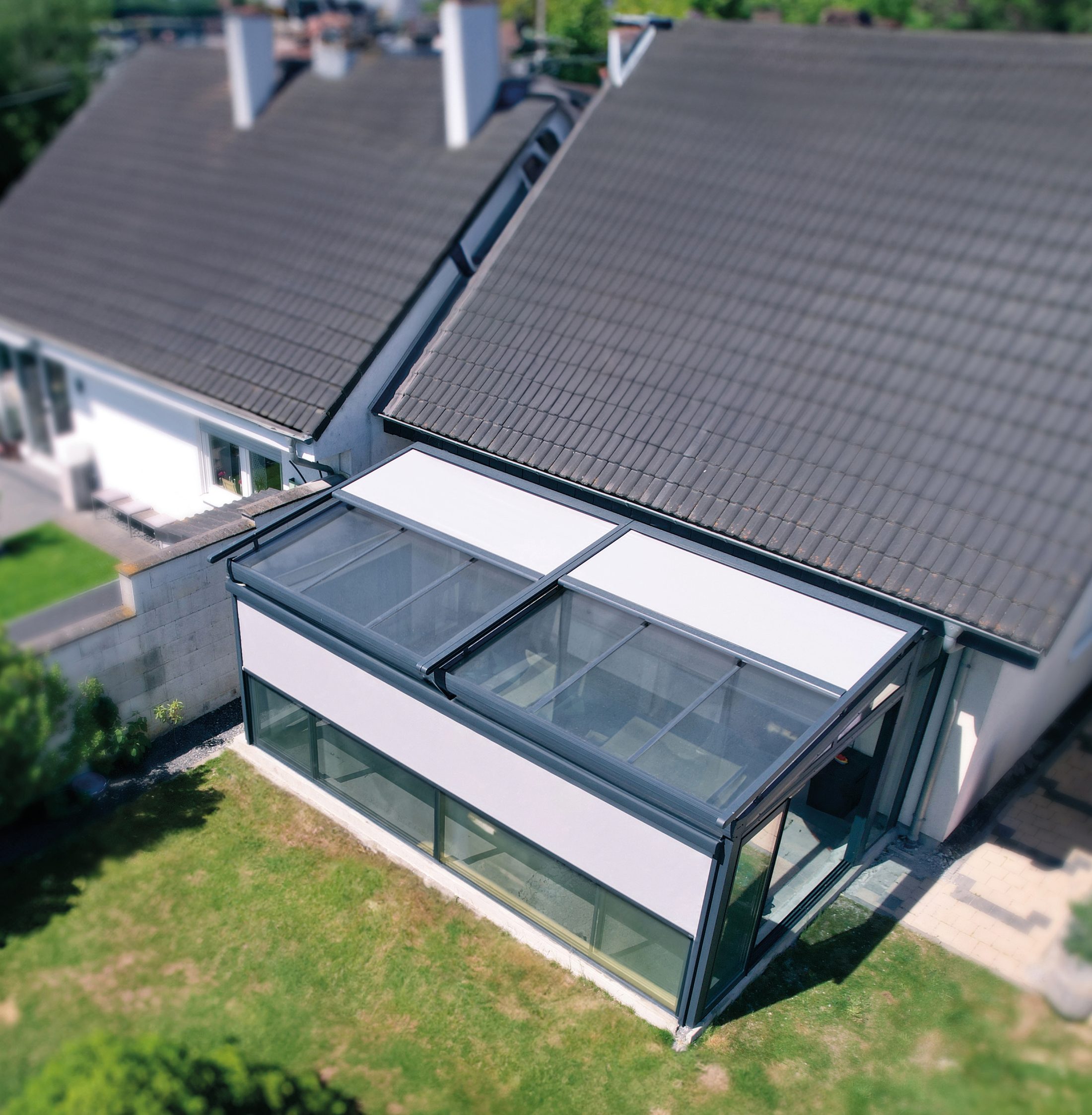
What is a zip screen and how does it work?
A zip screen is an outdoor screen whose fabric is locked into the side guides by zips along both edges. This guide explains how it works, how much wind it can take, which fabrics are used and how to choose between a vertical and a roof zip screen.
What is a zip screen?
A zip screen is a sun screen with screen fabric that rolls into a cassette and is installed outside a window, balcony, terrace or glass roof. What sets it apart from conventional outdoor blinds and awnings is its edges: a zip sewn along both edges of the fabric runs locked inside a PVC insert in the side guide. That is why the fabric does not flap in the wind and no light, insects or dust get in at the edges, while you can still see out from inside.
How does it work?
A zip screen has four main parts:
- Cassette: the aluminium box that hides the roller tube and the motor. The vertical Zipline Neo uses a 110 mm (Soft, Sharp, Wave) or a 130 mm (Sharp) cassette.
- Roller tube: the 78 mm galvanised steel tube the fabric winds onto; in motorised systems the tubular motor sits inside it.
- Side guides: the channels on either side. On the Neo they are 43 × 43 mm and made of three parts, with a PVC insert holding the zip and plastic springs that tension the fabric.
- Bottom bar: the weighted profile at the foot of the fabric; it pulls the fabric down and keeps it taut in every position.
When the motor turns the tube, the fabric unrolls from the cassette or winds back into it, while the zipped edges stay inside the guides. Because the weight of the bottom bar and the springs in the guides tension the fabric, the screen stays flat wherever you stop it. On roof installations (Zipline Sky-S) tension comes from a spring tensioning system in the bottom bar and a tension cord.
Can a zip screen withstand wind?
Wind is the weak point of any outdoor screen: fabric with free edges flaps at high speed, can tear and can bend the profiles. The zipped edge reduces this risk by holding the fabric on both sides. Our vertical zip screen Zipline Neo was tested in the METU RÜZGEM wind tunnel and withstood speeds of up to 172 km/h; the test report is on the certificates page. That is why it is also used in coastal areas and on windy façades. If a wind sensor is added to a motorised system, the screen retracts by itself at the wind speed you set.
Which fabrics are used?
Ferrini zip screens use Copaco and Serge Ferrari screen fabrics designed for outdoor conditions. They cut solar heat and glare while keeping the view outside. See the fabric catalogue for colour options. A waterproof fabric option is also available for roof installations. The aluminium parts can be painted in any RAL colour or given a wood-transfer finish, and an image or text can be printed on the fabric on request.
Vertical or roof zip screen?
The same zipped edge is used in two different systems: the vertical zip screen (Zipline Neo), which runs down the façade, and the roof zip screen (Zipline Sky-S), which is installed horizontally or at a slope over a glass roof or pergola.
| Zipline Neo (vertical) | Zipline Sky-S (roof) | |
| Application | Balconies, terraces, windows, façades, pergola sides | Winter gardens, glass roofs, over pergolas, skylights |
| Maximum width | 7000 mm | 6000 mm |
| Maximum height / projection | 4000 mm | 6000 mm |
| Maximum area in one piece | 16 m² | 24 m² |
| Wind resistance | 172 km/h | — |
Most terraces use both: a roof zip screen above cuts the sun, and vertical zip screens at the sides hold back the wind and low-angle sun. A detailed comparison is in the zip screen comparison.
How is it controlled?
The Zipline Neo can be controlled in six different ways depending on the project: remote control, wall switch, smart home system, crank, chain system or manual operation. In motorised systems the tubular motor is hidden inside the cassette, and wind and sun sensors can be added. The options are on the motors and controls page.
When is a zip screen not the right choice?
A zip screen keeps out sun, insects and wind, but it is not designed for blackout or security. If you want to black a room out completely and put a physical barrier in front of the window, a roller shutter may suit you better; if shade from above is enough, an awning may be the better fit. We have compared both line by line: roller shutter or zip screen? and zip screen or awning?
Frequently asked questions
Does a zip screen keep out insects and dust?
Yes. Because the edges of the fabric are locked into the side guides by zips, no insects or dust get in at the edges; when the screen is down it closes the opening from end to end.
Does a zip screen block the view outside?
No. Screen fabric cuts solar heat and glare but lets daylight through, so you can still see out from inside.
How large can a zip screen be?
The vertical Zipline Neo is made up to 16 m² in one piece (maximum 7000 mm wide and 4000 mm high), and the roof Zipline Sky-S up to 24 m² (6000 × 6000 mm). Larger openings are covered with more than one screen.
Can it be added to an existing building?
Yes. A vertical zip screen is installed inside the window reveal or on the façade, across a balcony opening or on the sides of a pergola; a roof zip screen goes over an existing aluminium or timber pergola or a glass roof. The dealer decides on the right mounting type during the site survey.
Measuring and quotation
Our zip screens are made to measure in our İzmir facilities and shipped to our authorised dealers as knock-down systems; your nearest Ferrini dealer handles measuring, fabric and motor selection, and installation.